HOME
TATTOO BLOG
SYMBOLS & DESIGNS
CELEBRITY TATTOOS
THE TATTOO PROJECT
TATTOO PHOTOS
TATTOO VIDEOS
TATTOO CULTURE
TATTOO MUSEUM
TRIBAL TATTOOS
TATTOO FACTS
TATTOO LINKS
SHOP DIRECTORY



 |
|
TATTOO CULTURETattoo Culture examines the rituals and social significance of tattooing in cultures around the world. The record of human history shows that tattoos have served in many various and diverse cultures as rites of passage, marks of status and rank, symbols of religious and spiritual devotion, decorations for bravery, sexual lures and marks of fertility, pledges of love, punishment, amulets and talisman, protection and as the marks of outcasts and convicts. PRISON &
GANG TATTOOS TATTOO REMOVAL - WHAT ARE THE OPTIONS? ANCIENT TATTOOS:
Theories of Heaven and Earth As tattooing increasingly enters mainstream culture, we ask: Are the tattoos we see on the catwalks of Paris, Milan, London and New York in any way connected to the body art still to be found in the jungles and ancient civilizations of Southeast Asia and the South Pacific? Why have tattoos been so important to their owners down through the ages? Why are they a universal phenomenon? And, finally, why are the traditions of tribal body art fast disappearing? Find out all this and more in Tattoo Culture. For the latest musings on Tattoo Culture, check in with Marisa at NeedlesAndSins.com For up to the date information on tattoos and body art in the Media, check out Tattoos in the News. For the history of Tattoo Culture, seek out Chuck Eldridge at TattooArchive.com. Survival International is the worldwide movement for tribal peoples. They help tribal peoples defend their lives, protect their lands, and determine their own futures. Tattoo Youth - Great pictorial spread by photographer James Macari 10 Reasons the Tattoo Community Doesn't Respect Tattoo Reality TV Shows I am speaking to you from deep within the trenches of this silent war. I reside inside of the tattoo community. I'm deep within the middle ranks of those that have lasted over 10 years in the trade. There is a war between the real traditionalists who are true to their craft and the tattoo rock and roll super star wannabes. This is more of a mentality than it is a style, per se. What I mean is that there are those of us who love tattooing for its rich history and the purity of the art form and then there are those of us who only care about what tattooing can get them. Some of us are in it purely for the art sake others are here for an ego boost. So with that said here are the reasons the tattoo community hates reality TV, without being too obvious. Plus some great new artists I have come to know about! See the 10 reasons here 25 Worst Tattoos in NBA History Tattoos are becoming increasingly popular in the NBA, as they are considered fashionable and a way for one to express himself. At what point, though, does it become overkill? more Why Do Chefs, and Especially Butchers, Love Tattoos? Q: A reader in Boston writes: What's up with chefs and tattoos? It seems I can't pass an open kitchen, or turn on a cooking TV show, without seeing tattoos, especially for butchers. Is that part of training now? A job requirement? A: I've wondered the same thing for a long time, particularly as Boston, which you might have noticed, has two early-adopter chefs, Andy Husbands of Tremont 647 and Jamie Bissonnette, now of Coppa, who are almost as known for their tattoos as for their food. But I really started wondering when I ran into a young woman at Jamaica Plain's gathering place for locavores, City Feed, who works as a hostess at our new Island Creek Oyster Bar (you've been, I hope? The ideal seafood bar and restaurant pre- and post-Fenway, as I wrote in my review for Boston Magazine). She introduced me to the friend she was with, who turns out to be a butcher at Whole Foods... more Tattoos conquer modern art as needles and ink replace brushes Like other top artists, Thomas Hooper has a signature style and can charge thousands of dollars for his best pieces. His name is known around the world and clients go to great lengths to seek him out for his vision, immense skill and keen sense of artistic purpose. But Hooper, 31, born in Bexhill-on-Sea and now the toast of New York, is neither a sculptor nor a painter, but a tattoo artist. For many, the difference between fine art and the cutting edge of modern tattooing has now virtually disappeared. "A lot of my work is to do with our own mortality and what could be called our souls," Hooper told the Observer as he sat in his studio, New York Adorned, where rock star Lenny Kravitz and DJ Samantha Ronson have been inked. more Extreme Makeover: Criminal Court Edition CLEARWATER, Fla. — When John Ditullio goes on trial on Monday, jurors will not see the large swastika tattooed on his neck. Or the crude insult tattooed on the other side of his neck. Or any of the other markings he has acquired since being jailed on charges related to a double stabbing that wounded a woman and killed a teenager in 2006. Mr. Ditullio’s lawyer successfully argued that the tattoos could be distracting or prejudicial to the jurors, who under the law are supposed to consider only the facts presented to them. The case shows some of the challenges lawyers face when trying to get clients ready for trial — whether that means hitting the consignment shop for decent clothes for an impoverished client or telling wealthy clients to leave the bling at home. more Mummy tattoos hint at ancient Andean acupuncture Tattoos left on a 1,000-year-old Andean woman may cover acupuncture points, archeologists report. In the current Journal of Archeological Science, a team led by Maria Anna Pabst of Austria's Medical University of Graz, "describe tattoos from two body areas of a mummy from Chiribaya Alta in Southern Peru." The team looked at the tattoos on the hands and neck of the mummy using various microscopic techniques. more Minor Iowa Arrest Makes Headlines Meet David Jonathan Winkelman - The Iowa man, 48, was arrested Thursday night by Davenport cops on a warrant for failing to appear in court to answer a misdemeanor charge of operating a motor vehicle without the owner’s consent, according to a jail booking sheet. But enough about Winkelman’s criminal entanglements, it’s his forehead tattoo that is worth further discussion. more Stick to the Script: Think Hollywood and text tattoos, and Robert Mitchum’s Love/Hate knuckles in Night of the Hunter (and later, Cape Fear) probably come to mind, or Guy Pearce’s body memoranda in Memento. But script ink has lately become trendy with starlets off-screen. “Fox of foxes,” Nietzsche wrote in Human, All Too Human. He was not referring to Megan Fox. But Fox’s tattoos refer to him (or, try to). Fox, the actress known more for her va-va-voom than her acting, is a fan of Nietzsche’s. Lately she’s been showing off this text tattoo: “Those who danced were thought to be quite insane by those who could not hear the music.” more Girl Talk: Life As A Tattooed Lady I live in New York City, where every third person on the street has some kind of ink. So it’s easy for me to forget that tattoos often have a whole different set of connotations in that wide swath of country between the East and West coasts. Luckily, the internet never hesitates to remind me. Since I started starring in a weekly web series, I’ve been called everything from a “tattooed longshoreman” to a “goblin.” (The goblin comment was probably unrelated to my tattoos, but it was still super mean.) And when a piece I wrote on weight loss for The Frisky ended up being featured on CNN.com, the photo featuring my tattooed arms quickly overshadowed the article’s content. more Tattoo Industry Surprisingly Recession Proof Coming in at #7 out 10 the tattoo industry is thriving, as the art becomes more culturally accepted and prevalent on television, in books and in malls. Costing anywhere from $50-200 per tat, inkers are cashing in on the desire to leave indelible marks. more Science Tattoo Emporium I once wondered aloud if scientists had tattoos of their science. The answer was yes, and this ever-growing collection is the evidence. THE TATTOO RENAISSANCE: ABSTRACT - This article presents an ethnographic account of product symbolism and fashion imagery within a segment of the consumer culture. This segment has emerged as an effect of the tattoo Renaissance and is referred to as the New Tattoo Subculture. After developing a historical interpretation, four a priori themes are discussed (i.e., Renaissance, extended self, risk, and satisfaction/addiction). Ethnographic support was found for these themes as well as two emerging themes (i.e., design versus act and the simulated self). The article concludes by exploring the implications of tattooing for identity formation. Read the rest of the article Young women most likely to get tattoos SAILORS and motorcycle gang members are synonymous with tattoos, but young women are now the demographic most likely to get inked. Tattoos are commonplace on red-carpet A-listers including David and Victoria Beckham, Angelina Jolie, Rihanna, even teen star Miley Cyrus and a new survey by Australian research company UMR has found women under 30 are the group most likely to find tattoos highly attractive. About 62 per cent like tattoos on men's arms the most. Natural Fashion: Tribal Decoration from Africa Natural Fashion: Tribal Decoration from Africa by Hans Silvester is going to be the fashion photography book of 2010. His photos are of the Surma and Mursi tribes in East Africa. These nomadic tribes travel vast distances and bring minimal materials with them on their journeys. For this reason, most of their fashions are taken on the go, directly from nature. Primarily, Silvester's photography book begins with a short description of the tribes. This introduction describes this nomadic nature among other reasons for their natural dress and how it is developed. Silvester demonstrates their face and body painting techniques and states that, without mirrors, their painting takes on natural lines and purposefully lacks precision. No two lines are the same and none of the faces painted are created to be alike. Read the rest of the 5 star book review here Queen Elizabeth II has to take a tattoo on the chin
Locals in the North Island town of Palmerston North have threatened to destroy a painting displayed in a framing store depicting a young Queen Elizabeth II with a traditional tattoo emblazoned across her lips and chin. The artist, Barry Ross Smith, told the Manuwatu Standard it was meant to be a sensitive depiction of two cultures coming together. But the locals aren't so sure... Read the rest of the article Who's passage is it?
Sovereignty: Aboriginals want their culture considered Aaju Peter never imagined her chin tattoo would be the subject of a parliamentary debate about Canada's sovereignty in the Arctic. But there she was last month, at a defence committee hearing, watching Inuit leader Paul Kaludjak as he pressed MPs to consider the views of Nunavut's aboriginal population -- and to honour the millennium of Inuit history in Canada's North -- before renaming the Northwest Passage the "Canadian Northwest Passage." Peter's facial tattoos -- including two thin blue lines inked beneath the 49-year-old Inuk's lower lip -- represent the revival of an ancient Inuit art largely lost after European missionaries arrived in the Arctic in the 1800s and voiced disapproval of the practice. Part of a wider reclaiming of traditional Inuit culture and identity in recent years, the tattoos have a surprising link to the Northwest Passage and to Canada's ongoing challenge to assert control over what this country considers "internal waters" but which the rest of the world -- most notably the U.S. -- sees as an "international strait." That jurisdictional challenge prompted the proposed addition of "Canadian" to all official references to the passage. The renaming idea, advanced as a Commons motion in early October by Conservative MP Daryl Kramp, was meant to symbolically bolster Canada's sovereignty over the shipping lanes through the country's Arctic islands. At a time when retreating sea ice and dreams of Arctic oil riches are fuelling unprecedented global interest in the polar realm, the bid to unambiguously identify the disputed passage as a Canadian waterway quickly won expressions of support from all three opposition parties and appeared to be headed for prompt adoption in the nation's legislature. And the tattoo? Kaludjak pointed out the passage is already known among many Inuit as "Tallurutik" -- a name derived from the tattooing ritual among Canada's Inuit and a feature on Devon Island at the eastern entrance to the passage. "Talluq is 'a chin' in Inuktitut and tattoos on the chin on a woman were called tallurutiit. That's where the name comes from," he said. © Copyright (c) The Province WITH ART AS THEIR ARMOR - Cambodian soldiers believe certain tattoos can protect them from bullets and landmines,
and even make them invisible. Reut Hath is one such magic man. He first learned the art of inking magic from his father, a farmer and martial arts trainer in northwestern Cambodia who was himself a "powerful magic man," according to the 52-year-old former soldier. "Many people came to [my father], so he gave some of the work to me," Reut Hath said. "So, I had to learn magic." Wherever Cambodian soldiers cluster, charms and amulets abound, from cloths scrawled with protection spells to bags of Buddha figurines to boar tusks - anything to gain a magically endowed edge over the enemy. And there is perhaps no more explicit display of belief in mystical powers than magic tattoos, geometric patterns of written spells and images that crisscross the bodies of many older soldiers... Read the rest of the article The Art and Stories of Tattoo Culture Is Love Skin Deep? FROM THE PARLOR TO THE PARLOR - Tattoos Muscle In Haute tattoos hit NYC, chardonnay included Nuggets Making Their Mark in Ink Chris "Birdman" Andersen, one would suggest, earned his wings - but, truth is, he bought them. A dude named John Slaughter, a local tattoo artist whom Andersen trusts like one of his Nuggets teammates, is responsible for the flame-colored wings under Birdman's biceps, arguably the coolest tattoos on a team coated with them... Read the rest of the article Our tattoos, ourselves Diaspora Drawn on the Body -
The global Samoan and the enduring art of 'tatau,' photographed by Mark Adams. A New Kind of Skin Magazine Lloyd Garver: Barbie gone wild? The Claim: Tattoos Can Increase the Risk of Skin Cancer Chinese craze for English tattoos Tattoos of Chinese characters have long been a fad in the West as a way of denoting the mystique of their bearers. But in a reversal of the trend, Chinese ink parlours are reporting a sudden craze among their clients for tattoos in English. Zhang Aiping, a tattooist at Tattoo 108 in Shanghai, said: "Around 30 per cent to 40 per cent of our customers are choosing tattoos in English letters now. This has happened really suddenly, since the beginning of this year. I just did one a few days ago for a footballer at Shanghai Shenhua club. It said: 'I miss u forever'." Read more Scientific and Geeky Tattoos: Are you serious? How committed of a science nerd or geek are you? If you're truly hardcore then maybe you'd like to show that permanently, in ink, on your skin. We've seen in past posts on GeekDad how geeklets can give tattoos to their parents. We've even seen some GeekDad contributors who have geek tattoos of their own. (Hi Z!) Here are some of the best of geek and science tattoos out there. Read more Hardy Vision: Cheerleaders' tattoo taboo can't seem to rub off This year's NCAA men's basketball tournament has been a bust in terms of games that leave indelible images. But I can draw up at least one interesting diversion to talk about. Which would you rather see -- a 64-field bracket competition to determine the best player tattoo ... or someone who actually has this year's entire NCAA bracket tattooed on his back? This year's game action has been forcing me to flip the remote. But in the games I do watch, I'm mesmerized by the tattoos. The typical starting five of today seems more suited to be commemorated in an art museum than a hall of fame. Players don't stick around campus long enough to write extensive chapters in their program's lore, but at least their tattoos tell an interesting life story: "This one's for my grandma, rest her soul ... this one's for my brother who's in prison ... this one's for my baby, whose mama I met at a tattoo parlor ... this one is for my cousin who was shot when a fight broke out while waiting in line for a tattoo ... this one I got on buy-one-get-one-free Tattoo Appreciation Day ..." Read more Tattooing's King Of Creepy He won't do unicorns, but for snakes and skulls, The dungeon-like room, lit only by small fluorescent lamps above three chairs, greets the customer with piercing heavy-metal music that sends vibrations through the floor. Flickering red candles illuminate the black walls, adorned with paintings and sculptures of monsters, skulls and bleeding faces. This isn't the set of a Nine Inch Nails' video. It's Last Rites Tattoo Theatre in Manhattan's Hell's Kitchen, where Paul Booth, 41, works his black magic. Much of his portly, 5-foot, 10-inch frame is covered in black tattoos. His favorite--running from the right side of face over the top and back of his buzzed-bald head--is an abstract design sketched by his mentor Felix Leu and inked by Leu's son Filip (Felix died of cancer before he could finish the job). A hoop ring hangs from between Booth's nostrils, and dark dreadlocks dangle from his nape to his knees--an incongruous presentation, given his warm smile and easy laugh. "I just see the darker side of life," he says... Read more Chinese tattoos popular with western celebrities Celebrity Chinese tattoos are indelible proof of the country's growing cultural clout, but also evidence that where body art is concerned local is global. Dragon and Mandarin character designs are ubiquitous in the West but less visible here, where a relatively conservative attitude toward tattoos still exists - they used to be the mark of criminals. While up to 35 percent of NBA stars have some kind of Chinese-themed motif inked into their skins, the number of Chinese sports stars or entertainers with tattoos is minimal. Since Dennis Rodman ("Ink not mink") broke the mold in the 1990s the NBA has become so tat obsessed that Yao Ming and Yi Jianlian's unblemished skins are the exception to the rule. Being a "bad boy" can be a positive selling point in the West, where individualism and thug culture like hip-hop is as likely to be celebrated as castigated. Marcus Camby of the LA Clippers wears his heart on his sleeve and has the Chinese characters "strive for the clan, the family" on his right arm. Allen Iverson, one of the most decorated NBA players, in terms of tats and stats, has the character for "loyalty"... Read more Kat Von D, Stretching Her Canvas Kat Von D strides into a bookstore in Lutherville, Md., on a rainy and overcast afternoon, looking like the wilder side of L.A. personified: Tall, thin, tattooed, electric, rock-star gorgeous. Black tights, three-inch heels on knee-length boots, a red bikini top under a black tank. Several rings, a cross-adorned necklace that drapes to her waist, red lipstick. Tattoos? Everywhere. Dark eye shadow, brown eyes, high cheekbones, standing maybe 6 feet in the heels. Some 500 people are jammed into the aisles. They've been waiting hours for her to sign copies of her glossy bio and book of skin ink, "High Voltage Tattoo." They're craning necks and holding up cameras... Read more Suicide girls get sizzling bacon 'bro' tattoos at SXSW Talk about bringing home the bacon. At Saturday night's Bigg Digg party at Stubb's BBQ in Austin, Texas, I ran across two young ladies from the tech world who were sporting brand-new, hot-off-the-grill bacon tattoos. Lynn LaVallee, a.k.a. @poshy, and her friend Jessica Zollman, a.k.a. @jayzombie, in town for the South by Southwest music and media conference, consummated their roommate-ship early. The two San Francisco-based women, both Suicide Girls (that's the Web's "enlightened" erotic-photo site), are moving in together next month, and they both love bacon. Hence the decision to get their "bro tatts." ... Read more Barbie is reinventing herself yet again... "Totally Stylin' Tattoos" Barbie has some parents pretty upset. She comes with a set of tattoo stickers, which can be placed anywhere on her body. The set also comes with a tattoo gun that's similar to a water gun. The gun allows kids to stamp tattoos on her clothes or themselves. Mattel says the tattoos for kids are temporary and wash off. Doll Collectors say this isn't the first time the company has pushed social limits. A few years ago, Barbie's best friend, Midge, was pregnant. Her bell would pop out a curly baby when opened. Complaints forced store like Wal-Mart to stop selling the doll in 2002. Despite some controversy, the new tattoo Barbie seems to be a hit and is selling out in several stores. Mattel says it has no plans to discontinue the doll. They say it gives girls a chance to express themselves. Americans' lasting mark on Iraq: colorful, complex tattoos Baghdad - Before US troops rolled into Iraq, Robert Eagle, an
Iraqi, had seen his fair share of tattoos. There were lots of
traditional Bedouin designs - simple patterns of lines and dots -
and prisoners who scrawled loved ones' names using ink and a sewing
needle, but nothing more complicated than this. Sometimes body art, business mix, sometimes they don't MILLERSBURG -- Generation Y has hit the job market. Some come ready to work, dressed in shirts, ties... and tattoos. While some employers can ignore visible ink, others have a more traditional, "don't ask, don't tell, don't show" stance. Nationally, Disney was known for years for a stringent dress code and policy regarding tattoos. But, according to CollegeRecruiter.com, the company lifted its tattoo ban after facing a talent shortage. According to a McDonald's employee handbook, no visible tattoos are allowed and a maximum of three ear piercings are allowed. Burger King's dress code is even more stringent. According to an employee handbook, no visible tattoos are allowed and only female employees are to have ear piercings. Those piercings are limited to 1-inch hoops or studs... Read more Gen--Yers Splash Out With Tattoos STUCK on the ideal present for someone turning 21? Think ink.
We're not talking about a nice pen set, according to a new survey,
but a tattoo. Tattoos - More For Her Than Him About one in five adult New Zealanders have been tattooed with women more likely to get one than men and young people. These findings are from a UMR Research survey of a nationally representative sample of 750 New Zealanders aged 18 years and over. The survey shows that 19% of adults have been tattooed, but if you are under 30 you are far more likely to have a tattoo than any other age group. In fact, one in three adults (36%) under 30 have been tattooed. Tattoos are more common for women too with 22% having been tattooed compared with 17% of men. "Polynesians gave the English language the word tattoo which is derived from the Samoan word tatau, so it should be no surprise that Pacific Islanders and Maori were also far more likely to have had tattoos than others," A UMR Director, Tim Grafton, said... Read more here The Tattoo Archipelago Historians speculate that the modern tattoo arrived in Russia in the nineteenth century care of English sailors, who mixed with Russian criminals when misbehavior got them jailed while docked in Russian ports. The English yen for tattooing can be traced to the explorer James Cook, who encountered tattoos while visiting Tahiti in 1769. Members of Cook's crew acquired tattoos as souvenirs during subsequent voyages to the South Pacific, and tattooed English sailors were soon appearing in port towns throughout Europe. By the twentieth century, artistically inclined Russian convicts were branding their prison mates regularly, using staples or syringes for needles and soot and urine for ink. Read the whole article here Some Tattoo Bearers Are Marked With Regret TAMPA - Johnny Gazel had regrets before the ink set on the tattoo on his thigh. "I knew it was a mistake the minute I saw it," says Gazel, 21, of the crude Chinese symbol created by a friend when he was 16. "The things you do when you're young. I'm not a tattoo person, and every time I look at it, I know it was a mistake. It's supposed to mean 'help' in Chinese, but who knows; it could say jerk." On his 21st birthday, Gazel turned to Tampa Laser Touch in Westchase to have the tattoo erased. Read the whole article here Vanishing act: Regret sends stream of customers to laser tattoo-removal clinics The stars all seemed to be in alignment. She was 16, a junior in high school. It was Christmas break in Springfield, Mo. She'd just awoken with a concussion after being involved in a sledding incident with a tree at 2 a.m. the night before. A friend was an amateur tattoo artist and needed gas money to get to Kansas City, pronto. And she had $5 in her pocket. What better time or place, then, to get a lemon-size tattoo of a fish put across her chest? "It sounds so cliche, but you just don't know at 16, almost 17... You're not thinking about your future. You're not thinking that when you're 30 you won't want a fish on your breast," said Wendi Walker. Read the whole article here The price of art? A piece of flesh Times may be tough this Christmas, but if you've got an art buff
on your shopping list, here's one way to get a bargain - go out and
get some ink. Tattoo's last taboo During the past couple of years, articles about whether to hide or proudly display one's tattoos and body piercings in the workplace have become a popular addition to many media outlets covering work/life balance issues. But yesterday, when I noticed that the Pew Research Center stat of the day stated that 36 percent of Gen Y has a tattoo and 40 percent of Gen X does, I had to wonder: Are people going to greater lengths to hide their body art in this tough job market? Before the bottom fell out this year and employers started
handing out pink slips like Altoids, the conventional wisdom was
this: Work in a traditional business sector like banking, finance,
or accounting, and you'd best cover up. (In other words, when in
Rome...) But work for a dotcom or a smaller, more creative firm, and
you'll often get more leeway with regard to body art. Once upon a pre-recession time, if a person was committed to working for an employer that didn't require them to hide their body art, they'd seek out more accepting companies by asking folks they knew about their company's culture, spying on employees in the parking lot during summer (when tattoos are more conspicuous), and consulting a web resource like ModifiedMind, which lists the body-art policies of dozens of employers. But with so many more people looking for work these days, are job hunters who get inked doing so in places that are easier to cover up (even in summer)? And are hopeful employees who already have body art taking greater pains to cover up, in the event that the hiring manager on the other side of the interview desk isn't tattoo or piercing friendly? I'm curious. And if you've got a story to share, either from the employee or employer side, I'd love to hear it. Freelance writer Michelle Goodman is the author of "My So-Called Freelance Life" and "The Anti 9-to-5 Guide." E-mail her at ninetothrive@nwjobs.com Body art and the recession: Are job seekers covering up more? New Hampshire resident Dotty Jenkins doesn't mind the stares. Her hairless scalp is covered with an intricate, colorful web of tattooed images, including flowers, butterflies, and a striking pair of eyes, literally in the back of her head. Tattoo culture under the spotlight David Beckham, Samantha Cameron and Amy Winehouse all share at
least one thing in common aside from their fame - a tattoo. Tattoos Gain Even More Visibility In a mysterious and inexorable process that seems to transform all that is low culture into something high, permanent ink markings began creeping toward the traditional no-go zones for all kinds of people, past collar and cuffs, those twin lines of clothed demarcation that even now some tattoo artists are reluctant to cross. Not entirely surprisingly, facial piercing followed suit. Suddenly it is not just retro punks and hard-core rappers who look as if they've tossed over any intention of ever working a straight job. Artists with prominent Chelsea galleries and thriving careers, practicing physicians, funeral directors, fashion models and stylists are turning up with more holes in their faces than nature provided, and all manner of marks on their throats and hands. Read the whole article here Is Love Skin Deep? A couple of weeks later, on our third date, he made me dinner at his place. By then, I was really liking what I saw: a handsome, short-haired, glasses-wearing guy who owned his own business and attended the ballet with his mom. I was admiring the way he decorated his apartment with both framed photos and living plants when suddenly his lips were on mine. Kissing him was even more warm and wonderful than I'd imagined. Then he pulled off his sweater, and something came between us. Technically, it was someone: a tattoo on his upper left arm of a vibrant, crazy, and most unmistakably skinless man. Not a skeleton, mind you; a man with no skin - just organs, graphically rendered in sickly red, orange, and yellow swirls. I was shocked by the aggressiveness of it. He'd seemed so ... normal. Gentle, even. "What is that?" I blurted. Read the whole article here Show Us Your Geek Tattoos Bountiful Utah restricts hiring of new employees with tattoos Tattoos are becoming more popular and part of mainstream culture. They can be seen on all kinds of people, but you won't see them on any new Bountiful City employees. The resolution was passed Tuesday and states, "Employees are prohibited from having any form of tattoo, branding, piercing (except for ordinary earrings for women), skin markings, or other forms of body art on the face, neck, head, and hands. Employee applicants with such items shall not be hired." More The Breakups That Got Under My Skin When our relationship ended I lay on my bed, hollow and hurting, unable to cry, going over the relationship with friends. I told them all the things you believe when you've been dumped: I'll always feel this way, I'm not worth loving and no one will ever love me again. Until one friend, surely exhausted by my relentless sorrow, suggested we get tattoos. The brother of a friend, she explained, was running a start-up tattoo business out of his dormitory room. Read the whole article here Flesh Tones The Mark of a True Science Fan? Thai Tattoo Tradition Draws Worldwide Devotees For centuries, Thai soldiers have covered their bodies in protective tattoos called Sak Yant. Today, the ancient ritual is booming and thousands of people - in Thailand and beyond - are flocking to master artists to have the powerful designs inked on their bodies. The Wat Bang Phra Buddhist temple, about 30 miles west of Bangkok, is one of the most highly esteemed locations for Sak Yant. Dozens of monks and master artists, who have spend years perfecting the art, can be found there. Horiyoshi III, Legendary Irezumi Master First, let's distinguish between the terms irezumi and tattoo: In Japan, they certainly have different meanings. "An irezumi is something that is normally hidden beneath clothing," Horiyoshi III says. "Many young people in Japan today are getting tattoos to show them off. That is very different." Branded with Science Tattoos Hinder Job Search, Says Vault Survey Said one survey respondent: "Regardless of who the real person may be, stereotypes associated with piercings and tattoos can and do affect others. In general, individuals with tattoos and body piercings are often viewed as 'rougher' or 'less educated.'" Despite such prejudice, only 16% of employers have an official company policy on tattoos and piercings. Vault found that over half of employees with tattoos and/or body piercings opt to cover up when they are at work. Forty-two percent of those surveyed admitted to having either a tattoo and/or body piercing (besides "pierced ears"). Of that group, 40% had one or more tattoos and only 20% had one or more piercings. Consistent with Vault's first Tattoo and Body Piercing Survey conducted in 2001, the most popular place to get a tattoo is the arm at 25%. Vault's 2007 Tattoo and Body Piercing Survey, conducted earlier this month, is comprised of 468 responses from employees representing a variety of industries across the U.S. The Word Made Flesh Bilderbuch-Frauen After Internet research, Schmalenberger visited several tattooed women in different cities throughout Germany and photographed them in large-format. Boris Schmalenberger is showing us tattooed women as human beings who differ from others because they express their individuality explicitly through their bodies; a concept which derives from a desire that fashion has long been failing to satisfy. In contrast to his earlier works, the photographer this time surprises by his choice of a documentary-like style to concern himself once more with one of the key themes of his oeuvre: human physicality. Nevertheless, these images prove to be aesthetic constructions that surpass merely copying reality by their poetically structured compositions: Thus, the title "Bilderbuch-Frauen" (picture-book women) is explicitly to be understood literary. more... Taboo of tattoos in the workplace Karman & Malinda's Top 11 Lesbian
Fashion Accessories A Portrait of "Generation Next" Thirty-six percent of those ages 18 to 25, and 40 percent of those ages 26 to 40, have at least one tattoo, according to a fall 2006 survey by the Pew Research Center. more Tattoos and Piercings Go Mainstream, but Risks Continue, NewsCenter, Northwestern University WHO'S TATOOED? MORE SKIN, LESS INK A short history of tattoos. TATTOOING
BURSTS THROUGH THE COLOR BARRIER SYMBOLS ON SKIN CONNECT HEARTS TO
HISTORY ALASKA One whaler wants to create a one-dimensional whale-tail necklace commemorating kills. Two women have chin markings that symbolize family and ancient traditions. It's perhaps the latest development in an ongoing effort by Alaska Natives -- at least two Aleuts also have facial tattoos -- to revive language, dancing and art. (read the whole article here) TATTOO AMONG THE NATIVES OF NEW ZEALAND POLYNESIA -- SAMOA TATTOOS The legends of Samoa describe how two sisters, Tilafaiga and Taema were sent from Manu'a to Fiji to visit the daughter of King Tuimanu'a. While there, they were presented with a gift from the royal family of King Tuifiti which was a tattooing instrument. While swimming home they carefully held onto their precious gift while singing a chant that the Fijians had taught them translating it into Samoan. In English, the chant would say "women are tattooed and men are not." (read the whole article here) TATTOOS, CANNIBALS and FREE LOVE Annexed by the United States in 1900, Samoa already had a lengthy history of tattoos and sexual practices that disturbed uptight Westerners. However, it took a little while for such things to get noticed. In 1722, the Dutch made a stop there, but decided that these tattoos, which descend from the waist to the ankles, were actually "artfully woven silk tights or knee breeches." Some French in 1768 thought it was paint. It took until 1787 for the expedition of Jan Francoise de la Perouse to discover that they were actually inkings. Unfortunately, La Perouse later decided to hoist an alleged Samoan thief up the mast of his ship by the man's thumbs. This led to what is called the "La Perouse Incident", wherein several of both parties were killed in a fracas. La Perouse later wrote, "I willingly abandoned to others the task of writing the uninteresting history of these barbarous people; a stay of twenty-four hours and the relation of our misfortunes has sufficed to show their atrocious manners." (read the whole article here) TATTOOING IN POLYNESIA SKIN DEEP GAY & LESBIAN PRIDE SYMBOLS WHEN A TATTOO NO LONGER SUITS YOU Once the exclusive domain of bikers, gangs and other rough riders, tattoos have gone mainstream with the help of TV programs such as "Miami Ink." Today, brokers and secretaries are just as likely as bartenders and street punks to have one. (read the whole article here) TATTOOS, PIERCINGS SLIP INTO DRESS CODES The 27-year-old - who has multiple masters degrees and a job at the University of Kentucky's research library - feels no pressure to cover up. "It's not really possible at this point, unless I wore gloves," Harris said, adding that she thinks academia has been more accepting of her body art than the corporate world would be. "I think my qualifications should speak for themselves." (read the whole article here) EARLY ROMAN TATTOOS TATTOOS USED 'TO IMPROVE APPEARANCE' DO NOT RESUSCITATE TATTOO Mary Wohlford, 80, has "DO NOT RESUSCITATE" emblazoned on her chest. Wohlford, of Decorah Dyersville, Iowa, got the ink in February to hopefully eliminate the possibility of any Terri Schiavo-esque controversy about her medical wishes should she become unable to communicate them directly. If all else fails, if family members can't find her living will or can't face the responsibility of ending life-sustaining measures, she said, then doctors will know her wishes by simply reading the tiny words that are tattooed over her sternum. Find out more here TATTOOS AND CORNROWS INKY DRAMA: NIKE SWOOSH UNDER THE SKIN Despite this move into the popular cultural realm, tattoos and extreme body modification do indeed remain for many marks of difference: cultural indicators of social deviance for some, a membership in a cultural group or collective for others, a rejection of mainstream western consumer culture for others still. Subcultural groups like the neo-primitives have continued, through resisting the sanitized, safe version of tattoos and by engaging in bricolage themselves, to maintain a counter-hegemonic subculture punctuated by extreme forms of body-modification. Neo-primitives value all forms of body modification less as art and more as a spiritual and ritualistic connectedness to the earth, the body and the "primitive." They exemplify the concept of the body as text. In an early 21st century world where bodies are sculpted to the ideals dictated by popular culture, the neo-primitives go to an extreme to claim dominion over their bodies in all forms. See his website for a in depth look at why people get tattoos. AMAZING TATTOOS YOU CAN'T HAVE UNMARRIED TATTOOED HEATHENS, HO! America is dead. No really, it is. And it's not just because we've lost habeas corpus, a bedrock protective law and a cornerstone of American freedom, to the rabid, stupid dogs of neoconservative fearmongering. That merely feels like a weird horror movie, the leatherfaced guy with the chain saw hacking off the head of the sexy college girl and laughing maniacally. The pain is simply too horrific and cartoonish to even register. Yet. No, Bush's ambling rape of the Constitution and moral law is not the true sign of social decay and devolution. There is a far worse problem lurking, lingering, sneaking up on American values like giant snakes slithering onto a plane. The real problem is, of course, tattoos. And piercings. And also: single people who defy the institution of marriage and choose to live together in sin. And then get tattoos. Haven't you heard? (see the whole article at SFGate.com) SKIN DEEP: CULTURE IS SKIN DEEP By LYNDA LIN, Pacific Citizen Assistant Editor SARAWAK MUSEUMS Urban Legends |
|
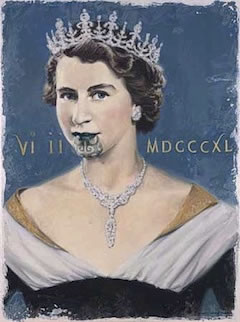 A CONTROVERSIAL portrait of Queen Elizabeth II with a Maori tattoo on her chin has raised the ire of Kiwi monarchists in New Zealand.
 |



