A Bronze Age tattooed man around 5,500 years old was found in October 1991
between Austria and Italy in the Tyrolean Alps. The Iceman, "Oetzi" is the
oldest known human to have medicinal tattoos preserved upon his mummified skin.
Cave of the Azil Farmhouse
Possible early evidence comes from an Upper Paleolithic cave, approximately
12,000 years old, excavated in the Pyrenees Mountains of Southern France,
know as the Grottes du Mas d'Azil (or Cave of the Azil Farmhouse).
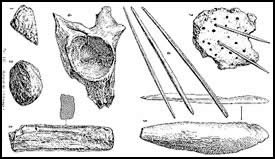
In 1962, Marthe Péquart published "Grotte du Mas d'Azil (Ariége), Une nouvelle
galerie magdalénienne" in Annales de Paléontologie. 48:167-296,
pp. 211-214. In that article, the illustration at right appears, showing the
tools of tattooing.
Cave at Hohlenstein-Stadel
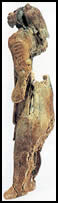
Germany has a long history of body decoration. In 1988, the carved figure at
right was found in a cave at Hohlenstein-Stadel, in Germany and was carbon-dated
to 32,000 years old. The carved body had thin lines running across the upper arm.
Tattoo Museum Bibliography, Resources and Links
 See all European Tattoo Culture Articles here
Additional Resources
NOVA Online
-- Transcripts | Ice Mummies: Return of the Iceman