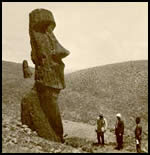
Easter Island 1772On Easter Sunday, 1722, the Dutch
navigator Jacob Roggeveen was in the South Pacific and sighted a small volcanic
island in the distance which was Easter Island that had developed in complete
isolation for centuries.
|
|
The ancestors of the Polynesians began to migrate from Southeast Asia about
1500 B.C., and at some time around 600-800 AD, arrived on Easter Island.
 |
The Easter Islanders, who today refer to themselves and to their homeland as
Rapa Nui, are the easternmost of some 36 Polynesian peoples whose ancestors
discovered and settled the islands of the central and eastern Pacific. They
share a common ancestry with other Polynesians, such as the Hawaiians, Tahitians
and the New Zealand Maori.
Rapa Nui Tattoos
All Rapa Nui art blends images of people and animals (anthropomorphic and
zoomorphic imagery) into superbly crafted and almost surrealistic forms. This
art inspired a number of Surrealist painters, particularly Max Ernst, whose
works often contain imagery after Easter Island art.
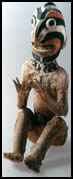
Five barkcloth figures (manu uru) are known to exist in museum collections
and all are decorated with paintings representing tattoos.
Picture to the right: Tapa barkcloth figure (manu usu). Reeds, bark cloth and paint, 19th century.
Forty cm. high. Note: facial and torso tattoos.
Throughout Polynesia, tattooing was widespread and often associated with
chiefly or warrior status. The face, neck, torso, back, legs, arms and top of
the head were tattooed.
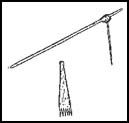 Tattoo Implements
Rapa Nui tattooing implements (ta kona) were similar to those found elsewhere in
Polynesia (a comb of bird bone lashed at a right angle to a wood handle). The
comb was dipped in a prepared pigment of charred ti leaves (Cordyline terminalis)
mixed with black nightshade (Solanum nigrum) juice and struck with a mallet into
the skin.
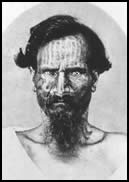
Juan Tepano, a Rapa Nui nobleman, 1870's
Only one photograph survives of traditional Rapa Nui tattooing. This 1870s
carte-de-visite, made by Tahitian photographer Madame Hoare, portrays Juan
Tepano, a Rapa Nui nobleman, with neck and facial tattoos. The Swedish
ethnographer Hjalmar Stolpe who traveled the Pacific in the 1880s also
illustrated him in portrait and profile views.
Juan Tepano's forehead tattoos consisted of six to ten solid vertical
stripes. The parallel lines across the forehead and the fringe of dots were the
first motifs tattooed on the face. This pattern was commonly recorded by early
voyagers. Beneath Tepano's chin and beard (on the throat) is a stylized bird
with head turned down, elongated body and wings reduced to four small tattoo
lines. This motif, also seen in other abstract versions on bark cloth figures,
is the frigate bird. The frigate, a predatory bird that flies swiftly and
cunningly, is widely associated with the tattoo traditions of several indigenous
peoples of Polynesia, Melanesia and Indonesia, and is symbolic of headhunting
and warfare. Also, on the right side of Tepano's spine is a set of nine parallel
lines, running vertically and bending to the right at the bottom, reminiscent of
a bird swooping downwards with wings outstretched. These same tattoos appear on
a bark cloth figure. Other tapa figures have more abstract images of birds on
their necks and hips.
By 1911, only four islanders out of 228 wore traditional tattoos, and these
were women. By 1930, only two survived.
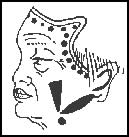 Generally speaking, Rapa Nui tattooing was comprised of fundamental motifs
preserved and passed from one generation to the next. Certain designs were more
common than others. Women and men very often had heavy lines on their faces,
which, crossing the forehead extended from one ear to the other. These lines
were curved and combined with a series of large dots (humu or puraki, "to
enclose") that marked the forehead and temples. On the cheeks of women below the
ears was a motif called pagaha'a (something that hangs heavy), formed by the
meeting of two designs, one triangular and the other fusiform (tapering at each
end). Tattooed rings (ngutu tika) surrounded the mouths of women, possibly akin
to the Maori custom, while three vertical lines descending the mouth sometimes
crossed the chin.
Generally speaking, Rapa Nui tattooing was comprised of fundamental motifs
preserved and passed from one generation to the next. Certain designs were more
common than others. Women and men very often had heavy lines on their faces,
which, crossing the forehead extended from one ear to the other. These lines
were curved and combined with a series of large dots (humu or puraki, "to
enclose") that marked the forehead and temples. On the cheeks of women below the
ears was a motif called pagaha'a (something that hangs heavy), formed by the
meeting of two designs, one triangular and the other fusiform (tapering at each
end). Tattooed rings (ngutu tika) surrounded the mouths of women, possibly akin
to the Maori custom, while three vertical lines descending the mouth sometimes
crossed the chin.
Tattoo Museum Bibliography, Resources and Links
 See all Eastern Oceania Tattoo Culture Articles here
Additional Resources
Tattoo History Source Book by Steve Gilbert
Trisha Allen - www.thepolynesiantattoo.com
See the Lars Krutak article
RAPA NUI SKIN: EASTER ISLAND INK for more
information about tattoos & tattooing in the Easter Islands.
Easter
Island Tattoos -- Some of the traditional designs and bit of
history
Meanings of Polynesian Tribal Tattoo Designs - Online Dictionary
NEXT >>
Maori / New Zealand